







Get the Benefits You Deserve After a Job Injury
After a workplace injury, you may be left with more questions than answers about your rights, your benefits, and how to move forward. While you may qualify for weekly compensation and medical coverage, securing those benefits can be far from straightforward.
At Bluestein Attorneys, we represent injured workers and their families across South Carolina. Our legal team fights for fair benefits and stronger protections for workers statewide. If you’re not sure where to begin, we’re here to help.
Call us at (803) 779-7599 or fill out the form to schedule a free workers’ compensation consultation.
Below, you’ll find answers to common questions and key information to help you understand your rights and take the next steps after a work-related injury or illness.
What is Workers’ Compensation?
According to SC’s Code of Laws, Workers’ Compensation is a type of insurance that provides benefits to employees who suffer work-related injuries, illnesses, or diseases, regardless of who was at fault.
The Workers’ Compensation system was formally established in South Carolina in 1935, and it has evolved over the years alongside changes in workplace environments, machinery, and technology.
Nevertheless, the purpose of Workers’ Compensation has remained the same: to guarantee compensation for employees incapacitated due to work-related conditions during the period of recovery.
From our blog:

Video Playlist: Workers’ Compensation Q&A


Who Is Covered by Workers’ Compensation in SC?
Generally speaking, every South Carolina employer and employee is presumed covered by the South Carolina Workers’ Compensation Act.
However, there are some exceptions.
The exceptions to this rule include:
- South Carolina federal employees
- Workers at a business which employs fewer than four people
- Workers at a business with an annual payroll of less than $3,000.00
- Agricultural employees
- Independent contractors
- Railroad and railway express companies and employees
- Certain real estate salespeople
- “Casual employees”, or workers with employment that is occasional, incidental, and without regularity (SC Legislature, 42-1-360)
Common Causes of Workplace Injuries
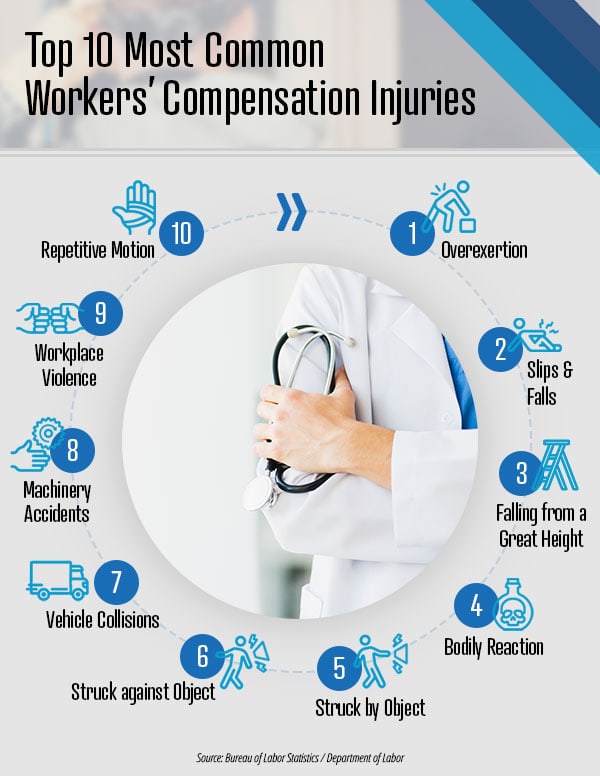
The most common workplace injuries covered by Workers’ Compensation are:
- Overexertion
- Slips, Falls, and Trips (including Falling from a Great Height)
- Bodily Reaction
- Struck by or against Object
- Vehicle Collisions
- Machinery Accidents
- Workplace Violence
- Repetitive Trauma/Motion
Types of Injuries and Illnesses Covered by Workers’ Compensation
Workers’ Compensation is designed to provide financial support and medical benefits for employees who suffer work-related injuries or illnesses, but not every injury automatically qualifies. Coverage depends on how and where the injury occurred, as well as the circumstances surrounding it.
Injuries and Illnesses Generally Covered
- Accidents that occur on the job or while performing work-related duties
- Injuries that develop over time, such as carpal tunnel syndrome or back strain
- Injuries sustained off-site while performing work duties, such as a technician being hurt at a client location
Injuries Generally Not Covered
- Self-inflicted injuries
- Injuries caused by intoxication or drug use
- Injuries from fighting or horseplay
- Violations of company policy or safety rules that directly contribute to the injury
- Injuries during commuting, unless the employee was performing a specific job-related task during travel
- Mental health conditions, such as stress or burnout


The Four Types of Workers’ Compensation Benefits in SC
Medical Benefits
Cover all reasonable and necessary medical treatment for work-related injuries or illnesses, including doctor visits, hospital stays, surgeries, medications, and physical therapy. Note that your employer (or their insurance company) can choose the treating physician.
Temporary Disability Benefits (Lost Wages)
Provide partial wage replacement for employees temporarily unable to work due to a job-related injury. Benefits are classified as Temporary Total Disability (TTD) or Temporary Partial Disability (TPD), depending on the employee’s ability to work in a limited capacity. Payments are typically two-thirds of the average weekly wage, with a seven-day waiting period unless the worker is out for more than 14 days.
Permanent Disability Benefits
Compensate for permanent impairments resulting from work-related injuries. These benefits aim to replace lost wages and are classified as either Permanent Total Disability (PTD) or Permanent Partial Disability (PPD), depending on the severity of the impairment. The amount awarded for PPD is based on several factors, including the severity of the impairment, the specific body part affected, and the worker’s average weekly wage.
Death Benefits
If a worker dies as a result of a job-related accident or illness, South Carolina law allows eligible dependents to receive death benefits. These benefits generally include a portion of the deceased employee’s average weekly wage, as well as coverage for funeral and burial expenses. Additional compensation may be available depending on the specific circumstances and the number of dependents.


How to File Workers’ Compensation in SC?
| DO | DON’T |
|---|---|
| Report the injury or illness to your supervisor or employer immediately (no longer than within 90 days). | Don’t delay reporting; waiting too long could put your benefits at risk. |
| Fill out all required Workers’ Compensation forms, and keep copies for your records. | Don’t rely on your employer to maintain complete or accurate records on your behalf. |
| Take your own notes and ask for copies of any documentation related to your injury or treatment. | Don’t trust others to keep track of your medical needs or paperwork. |
| If your supervisor doesn’t acknowledge the injury, escalate to HR or higher management. | Don’t stop pursuing acknowledgement if you’re being ignored. |
| Consult a Workers’ Compensation attorney if your injury goes unacknowledged or your claim is denied. | Don’t miss the two-year deadline to file a formal claim; it could bar you from receiving benefits. |
Avoid These Common Workers’ Compensation Filing Mistakes
Even if you rightfully deserve benefits, small missteps in the claims process can lead to reduced benefits or even a denial. To protect your rights and ensure you receive the full compensation you’re entitled to, it’s important to steer clear of these common errors:
- Delaying the report of your injury beyond the required timeframe (90 days)
- Failing to seek appropriate medical treatment
- Submitting incomplete or inaccurate information on your claim
- Misrepresenting the nature or extent of your injury
- Neglecting to consult with an experienced Workers’ Compensation attorney
Should You Settle Your Workers’ Compensation Claim?
Deciding whether to settle your Workers’ Compensation claim is not a simple yes or no; it depends on the specifics of your situation. If you’ve been injured on the job and have received a settlement offer, ask yourself:
Will settling my claim benefit me more than having the Workers’ Compensation Commission decide the outcome?
But by any chance, this is not a decision you should make alone. Always consult an experienced Workers’ Compensation attorney before agreeing to a settlement. A qualified legal professional can review your records, explain the proposed terms, and help you understand the long-term impact of settling versus continuing your claim through the Commission.

Frequently Asked Questions
Report all injuries at work to your employer immediately and request medical treatment, if needed. If you neglect to report the injury within 90 days of the accident, you may lose your rights to workers’ compensation benefits.
Although you must report the injury within 90 days, you have up to two years to file a claim for benefits. If a worker dies because of work-related injuries, the worker’s dependents, or parents if there are no dependents, must file a claim within two years of the death to claim benefits.
You are entitled to all necessary medical treatment that is related to your work injury and is likely to lessen your disability. Workers’ compensation insurance companies generally pays for surgery, hospitalization, medical supplies, prosthetic devices, and prescriptions. Keep in mind that in order to receive these benefits you must go to the doctor chosen by your employer or its insurance representative.
In short, probably not. Workers’ Compensation laws require the employer to pay for 100% of medical expenses related to the injury, but the law also allows the employer to choose which doctor provides the treatment. It’s possible that your employer will allow you to use your own physician, but it doesn’t happen often.
You are entitled to compensation at the rate of 66 2/3 percent of your average weekly wage based on the four quarters prior to your injury, but no more than the maximum average weekly wage determined each year by the South Carolina Employment Security Commission. If you were working two or more jobs at the time of accident, those wages may be included as part of the average weekly wage and compensation rate.
There is a seven-day waiting period before benefits can be paid. If you are out of work for more than seven days, payments will come from your employer’s insurance representative. If you are out of work for more than 14 days, you will receive compensation even for the first seven days.
You can expect payments to be made directly to you and these should continue until the doctor releases you to return to work.
For many serious workplace injuries, medical treatment will include some level of physical therapy or specialized care, which may require regular travel and fuel costs. Workers’ Compensation will cover travel expenses for medical care related to your workplace illness or injury. SC Workers’ Compensation laws require the employer to reimburse an injured employee at the IRS mileage reimbursement rate for all travel to medical appointments more than 10 miles round trip. You can see the most recent mileage rate charts here on the South Carolina Workers’ Compensation Commission website.
Workers’ Compensation is designed to provide benefits to injured employees without a specific need to prove who was at fault for the accident or injury. While situations such as self-inflicted injuries or injuries that occur as a result of an employee’s intoxication will not be covered, most employees will not need to provide proof that they were not at fault when filing for Workers’ Compensation.
Not necessarily. South Carolina is an employment at will state. This means that, absent a collective bargaining agreement or contract, employment can be terminated at any time without reason, explanation, or warning as long as that reason is not against public policy and/or illegal. The FMLA, or Family Medical Leave Act, provides some limited protections for many South Carolina employees, but not all employees in the state of South Carolina are covered by the FMLA. You can learn more about FMLA eligibility and what is covered by it here.
If you are cleared to return to full work duties, or limited work, by a physician after your recovery, but find that the work is not provided by your employer, you may be entitled to additional temporary disability benefits. These situations are very dependent on specific facts in each unique case, and consultation with a Workers’ Compensation attorney is recommended to determine your best option moving forward.
You must accept light work if it is offered. If you do not accept the light duty offered to you, all compensation may cease as long as you refuse to return to work. You have a right to a hearing if you believe that you are not able to do the work assigned to you.
If you return to light work before you are fully discharged by the doctor at a wage less than you were earning at the time of your original injury, you are entitled to weekly compensation at the rate of the sixty-six and two-thirds (66 2/3%) percent of the difference between your average weekly wage and your new wage.
In most cases, Workers’ Compensation benefits are not taxable at either the federal or state level. The IRS generally exempts weekly payments, lump-sum settlements, medical reimbursements, and survivor benefits from income tax, so long as they are paid under a Workers’ Compensation Act for a work-related injury or illness.
Workers’ Compensation claims can be denied for a variety of reasons, such as a pre-existing condition, missed deadlines, or lack of medical documentation. If your claim is denied, the first step is to carefully review the denial letter to understand the reason behind the decision.
If you decide to appeal, it’s important to act quickly (strict deadlines apply) and consult with an experienced Workers’ Compensation attorney. A lawyer can help you navigate the appeal process, gather the necessary medical and vocational evidence, and improve your chances of securing the benefits you deserve.
How Can Legal Representation Help with Workers’ Compensation?
After a work-related injury, you might expect the process to be simple: report the injury, get medical care, and receive benefits through your employer’s Workers’ Compensation insurance. Unfortunately, that’s not always how it goes.
In many cases, injured workers face delayed or denied claims, pressure to accept low settlements, or difficulty getting the medical care they need. Employers and insurance companies are focused on protecting their own interests, not necessarily yours.
At Bluestein Attorneys, we understand how frustrating and confusing this process can feel. Our team is here to guide you, protect your rights, and help ensure you receive the full benefits you’re entitled to. As part of your case, we can:
- Gather and organize strong medical, vocational, and expert evidence
- Help coordinate care with approved physicians and obtain independent medical evaluations
- Represent you at depositions and hearings
- Document how your injury affects your ability to work and live
- Negotiate with the insurance company to pursue a fair settlement
- Evaluate long-term medical costs and future earning potential
- Review any proposed settlement to protect your financial future
The sooner you involve an attorney, the better. Acting early can help preserve critical evidence and avoid costly mistakes in the claims process. Bluestein Attorney’s team is here to help you understand your options and take the next step forward with confidence